Common Electrical Problems Requiring Professional Diagnostics
Massachusetts properties experience diverse electrical challenges influenced by regional weather extremes and architectural eras. Coastal salt air on the South Shore can accelerate corrosion on exterior service meter jaws and disconnects, while historic homes throughout the Merrimack and Pioneer valleys often feature mixed generations of wiring. Common service issues evaluated by independent network contractors include:- Recurring Breaker Trips: Often caused by overloaded branch circuits, deteriorated breaker contacts, ground faults, or hidden short circuits inside wall cavities.
- Flickering & Dimming Lights: May signal loose neutral connections at the main service panel, utility voltage fluctuations, or undersized conductors struggling under major motor loads like air conditioning compressors.
- Discolored or Hot Outlets: Heat build-up at receptacle faces indicates loose screw terminals or back-stabbed connections, creating immediate localized fire risks.
- GFCI & AFCI Failure: Ground-Fault and Arc-Fault Circuit Interrupters are essential safety devices mandated by 527 CMR 12.00. Defective units must be replaced to restore life-safety protection in bathrooms, kitchens, and bedrooms.
The Diagnostic Assessment Process
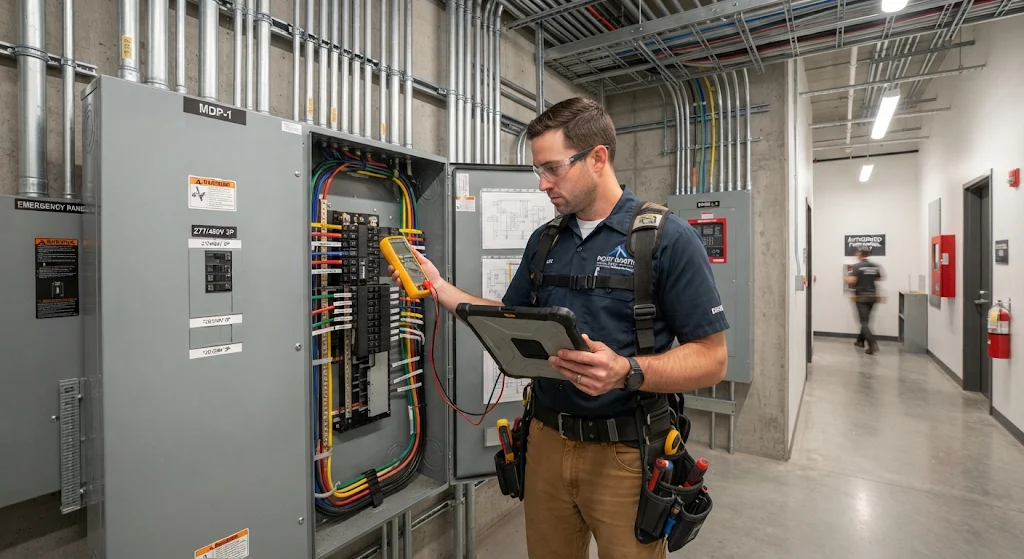
Accurate electrical repair begins with rigorous diagnostic testing rather than guesswork. Independent licensed Journeyman and Master electricians utilize calibrated digital multimeters, thermal imaging cameras, and circuit load analyzers to trace faults safely:- Circuit Tracing & Load Verification: Verifying actual amp draw against branch circuit breaker ratings to identify overloaded conductors.
- Thermal Inspection: Scanning breaker panels, bus bars, and junction boxes for dangerous thermal hot spots caused by high-resistance connections.
- Grounding & Bonding Integrity: Ensuring the property's electrical system has a continuous, low-impedance path to earth via grounding electrode conductors and ground rods.
- Code-Compliant Repair Execution: Replacing damaged conductors, torquing terminal lugs to manufacturer specifications, and installing modern UL-listed safety devices.
Critical Safety Protocols During Diagnostic Power Failures
When experiencing an electrical anomaly in your home or commercial building, safety must remain the absolute priority. Never touch a sparking breaker, buzzing meter socket, or water-damaged panel. If safe to access, switch off the main service breaker to cut power to downstream branch circuits. When independent electricians arrive, they conduct a methodical isolation procedure to test line-side voltage stability before opening energized enclosures. Furthermore, Massachusetts fire safety statistics show that arc-fault conditions caused by damaged cord insulation or loose receptacle terminals account for a substantial percentage of residential electrical fires. Utilizing licensed trade professionals to diagnose and repair circuits ensures proper wire gauge ampacity, torque calibration on screw lugs, and the restoration of UL-listed overcurrent protection.
Massachusetts Electrical Code & Permitting Regulations
Under the Massachusetts Electrical Code (527 CMR 12.00 / NFPA 70) and M.G.L. Chapter 143, Section 3L, electrical work in Massachusetts is regulated to protect life and property. Except for minor like-for-like device replacements exempted by local ordinance, electrical alterations and circuit repairs require an electrical permit pulled by a licensed Master Electrician with the local municipal Inspector of Wires. Independent contractors in our network handle all permitting documentation and coordinate official municipal inspections upon completion.Connecting with Independent Electricians Through WATT911
WATT911 serves as an independent connection resource for Massachusetts property owners. We do not dispatch proprietary field crews or perform electrical work directly. When you call our network line at (888) 605-9975, we match your request with an independent, licensed electrical contracting business serving your municipal jurisdiction. You communicate directly with the licensed contractor to review project parameters, obtain written estimates, and verify insurance.